The website design process is a structured, phase-by-phase methodology that transforms business goals into a site built to generate leads and conversions. Professionals in the field refer to this as the web design workflow, and it typically spans seven to eight distinct phases: discovery, information architecture, visual design, content, development, testing, and launch. Skipping or compressing any phase increases cost, delays timelines, and produces sites that underperform. Understanding each step gives you the clarity to manage vendors, set realistic expectations, and protect your investment from the start.
What are the essential phases of the website design process?
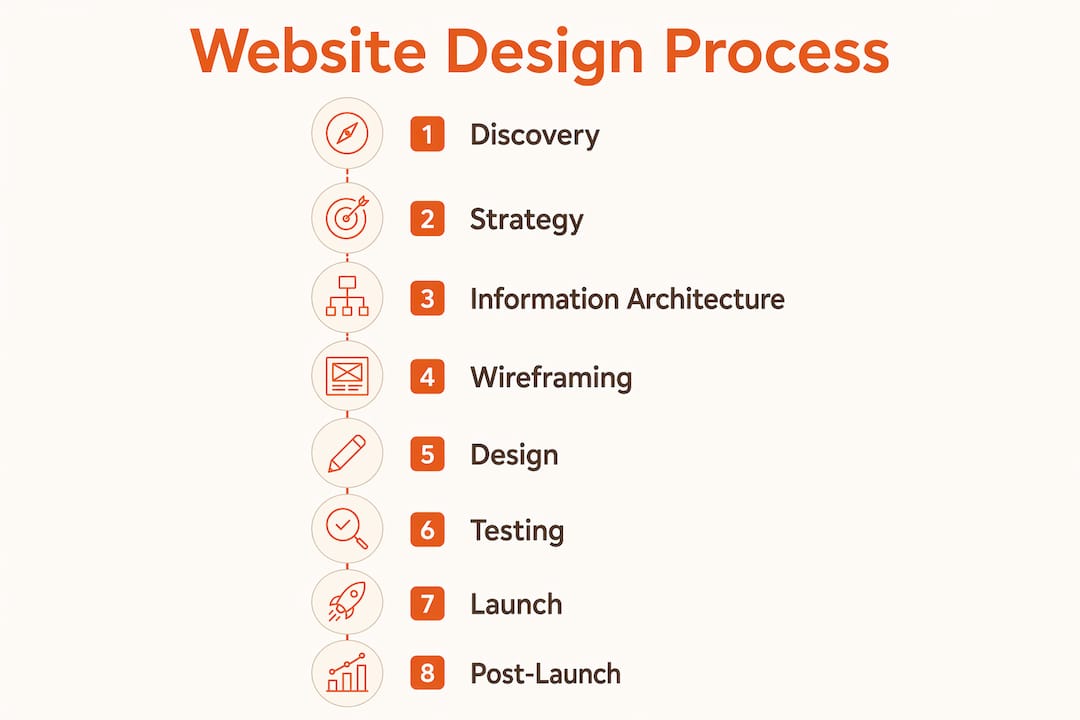
Professional agencies follow a 7 to 8-phase process that moves from strategy to launch in a defined sequence. Each phase has clear deliverables and exit criteria before the next begins. Here is how the full workflow breaks down.
- Discovery and strategy. This phase defines business goals, target audience, competitive positioning, and success metrics. A thorough discovery process prevents misalignment between what you want and what gets built.
- Information architecture and wireframing. The team maps the site structure, page hierarchy, and user journeys before any visual design begins. This phase produces a sitemap and low-fidelity wireframes.
- Visual design and prototyping. Designers apply brand identity, color, typography, and layout to the wireframes. Stakeholders review and approve a high-fidelity prototype before development starts.
- Content creation and SEO. Copywriters produce page copy aligned to buyer stages, and SEO structure is applied to headings, metadata, and internal links. Content is not a finishing step. It is a core design input.
- Development and implementation. Developers build the approved designs into a functioning website. Front-end and back-end work happens here, along with CMS configuration and third-party integrations.
- Testing and quality assurance. QA typically lasts one to two weeks and covers browser compatibility, mobile responsiveness, load speed, form functionality, and accessibility. Nothing ships without passing this gate.
- Launch and post-launch optimization. The site goes live, and the team shifts to monitoring performance, fixing issues, and iterating based on real user behavior.
Pro Tip:
Never skip the discovery phase to save time. Teams that jump straight to design routinely rebuild navigation and page structures mid-project, which costs far more than a thorough upfront strategy session.
How does content strategy integrate into the website design process?
Content should be planned during discovery, not after design approval. This is the single most overlooked rule in web design workflows, and it causes more project delays than any technical issue. When copy arrives late, designers retrofit layouts around words that do not fit, and the messaging ends up generic.
The right approach is to treat content as design. Planning copy aligned to buyer stages before wireframing improves message clarity and conversion potential. That means mapping the questions your buyers ask at each decision stage and writing answers before a single layout is drawn.
Structuring content for both humans and AI search is now a baseline requirement. An answer-first content structure with FAQ sections, statistics, and schema markup increases AI search visibility by up to 40%. That is a significant advantage for businesses competing for organic traffic in 2026.
Best practices for content strategy within the design process:
- Map buyer questions by decision stage before wireframing begins
- Write page headlines and key messages before layout is finalized
- Apply schema markup and FAQ sections to high-value pages
- Assign a content owner for each page, not just a general writer
- Audit existing content for gaps before starting a redesign
Pro Tip:
Treat your content brief the same way you treat a design brief. Define the goal of each page, the audience it serves, and the action you want visitors to take. Hand that brief to your writer before the wireframe is drawn.
What role do information architecture and wireframing play in successful website design?
Information architecture, commonly called IA, is the practice of organizing a site’s pages based on user journeys, priorities, and internal linking. IA improves both navigation and SEO by ensuring users and search engines can find content through a logical structure. Poor IA produces sites where visitors cannot find what they need, and where search engines cannot determine which pages matter most.
Wireframing is the step that follows IA. A wireframe defines page layout, content placement, and calls to action without applying any visual styling. Think of it as a floor plan for a building. You confirm the rooms are in the right place before you choose the paint color. For guidance on structuring a new site from scratch, Expedition’s resource on planning website architecture covers the practical steps in detail.
The distinction between wireframes and prototypes matters for stakeholder reviews.
| Element | Wireframe | Prototype |
|---|---|---|
| Visual styling | None | Full brand design applied |
| Interactivity | Static | Clickable, simulates user flow |
| Purpose | Layout approval | Design and UX validation |
| Stage in process | Before visual design | After visual design, before development |
| Stakeholder use | Structural feedback | Final approval before coding begins |
Starting development on unapproved wireframes or designs is the most expensive workflow failure in web projects. Costly changes compound when developers must rework coded pages because a layout was never formally approved. Exit criteria at each phase prevent this.

How do testing, launch, and post-launch activities ensure long-term success?
Testing is not optional, and it is not a quick checkbox. QA covers every functional and visual element of the site across devices, browsers, and screen sizes. A site that looks perfect on a desktop and breaks on a mobile device loses visitors immediately. Designing a responsive website is a non-negotiable standard, not a bonus feature.
Post-launch is where many businesses lose momentum. The site goes live, the team moves on, and no one owns ongoing performance. Governance models that define content ownership, publishing permissions, and audit schedules before launch sustain long-term site coherence. Without that structure, design consistency dissolves within months as team members change and priorities shift.
Key post-launch tasks every business should plan for:
- Monitor Core Web Vitals scores and page load speed weekly
- Review form submissions and conversion paths monthly
- Conduct a full content audit every six months
- Assign a named owner for each content section
- Schedule a design review at the 90-day mark to catch drift
- Use design-driven CRO to improve conversion rates based on real user behavior
A local service business launch checklist can help you confirm technical readiness before going live, covering items like redirect mapping, analytics setup, and sitemap submission.
Key takeaways:
A structured website design process, from discovery through post-launch governance, is the single most reliable way to build a site that generates leads and holds its value over time.
| Point | Details |
|---|---|
| Discovery sets the foundation | Skipping discovery causes misalignment and expensive rework in later phases. |
| Content belongs in phase one | Plan copy by buyer stage before wireframing to improve clarity and conversions. |
| Wireframe approval prevents waste | Written sign-off before development starts eliminates the most costly revision cycles. |
| Governance sustains performance | Define content ownership and audit schedules before launch to maintain site coherence. |
| Post-launch is an active phase | Monitor Core Web Vitals, conversion paths, and content health on a regular schedule. |
What I’ve learned from watching projects skip the hard parts.
I have watched businesses invest real money in websites that underperformed within a year. The pattern is almost always the same. The discovery phase gets compressed because everyone is eager to see designs. Content gets handed off to a writer after the layouts are approved. And governance, the question of who owns what after launch, never gets answered at all.
The uncomfortable truth is that most website problems are not design problems. They are process problems. A site with mediocre visuals and a clear content strategy will outperform a beautiful site with no structure every time. Buyers do not convert because a site looks good. They convert because the right message appears at the right moment in their decision process.
The other thing I have seen consistently is that stakeholder alignment early in the project saves more time than any tool or shortcut. When the people who will approve the final site are involved in wireframe reviews and content briefs, the feedback at launch is minor. When they see the site for the first time at the end, the revisions are significant and expensive.
Build the process before you build the site. The phases exist because they work.
How Expedition approaches the full website design process.
Expedition manages the complete web design workflow in-house, from discovery and content strategy through development, testing, and launch. Every project is handled by a U.S.-based team, with no offshore handoffs. That means the same people who built your site handle your post-launch maintenance and conversion work. For businesses ready to build or rebuild with a process that actually holds together, Expedition offers website redesign services built around strategy, not just aesthetics. Contracts are month-to-month with no onboarding fees, and Expedition price-matches existing scopes when you move over from another provider.
FAQ
What are the main phases of the website design process?
The website design process typically follows seven to eight phases: discovery and strategy, information architecture, visual design, content creation, development, testing and QA, and launch with post-launch optimization. Each phase has defined deliverables and requires approval before the next begins.
How long does a website redesign take?
Website redesign timelines range from 6 weeks to 6 months depending on scope, stakeholder alignment, and technology choices. Content readiness and compliance audits are the most common factors that extend schedules.
Why does content strategy matter in web design?
Content is often the primary bottleneck in web design workflows. Planning copy during discovery, rather than after design approval, prevents delays and produces messaging that fits the layout and serves the buyer’s decision process.
What is the difference between a wireframe and a prototype?
A wireframe is a static layout showing page structure without visual styling. A prototype adds brand design and interactivity, allowing stakeholders to click through the site and validate the user experience before development begins.
What should happen after a website launches?
Post-launch work includes monitoring Core Web Vitals, reviewing conversion paths, auditing content, and maintaining a governance model that assigns ownership for each section of the site. Without this structure, site performance and design coherence decline over time.