
The discovery process in web design is defined as the structured preliminary phase where a project team gathers research, defines objectives, and establishes scope before any design or development work begins. Known formally as the discovery phase, this stage is the single most consequential part of the web design process. Projects that skip it face 50 to 150% budget overruns from scope creep and rework. Projects that invest in it control cost variance to 10 to 20%. The discovery phase produces concrete deliverables including user personas, SEO audits, sitemaps, and risk registries that feed directly into design and development contracts.
What is the web design discovery phase and what does it include?
The web design discovery phase is a research and planning stage that answers three questions before a single page is designed: What problem are we solving? Who are we solving it for? What will it take to solve it well? Without clear answers, every subsequent decision in the project rests on assumptions rather than evidence.
Effective discovery follows a four-stage structured model with defined time allocations:
- Understanding (25% of discovery time). This stage covers stakeholder interviews, market research, competitive analysis, and user research. The team documents business goals, user needs, technical constraints, and content requirements. Rushing this stage is the most common failure point in web projects because it means the team solves the wrong problem with precision.
- Designing (35% of discovery time). Initial wireframes, user flows, and information architecture drafts take shape here. These are not finished designs. They are low-fidelity representations used to test assumptions and communicate structure before committing to visual design.
- Validating (25% of discovery time). Stakeholders, users, and subject matter experts review the outputs from the designing stage. Feedback is documented and incorporated. This is where misalignments surface at a fraction of the cost they would create later in development.
- Planning (15% of discovery time). The team produces a project roadmap with milestones, a technology stack recommendation, a risk registry, and a maintenance plan. These outputs form the foundation for the main development contract.
The discovery phase typically lasts two to eight weeks depending on project size. Small projects under six months require roughly two weeks. Mid-sized projects running six to twelve months need three to four weeks. Large projects exceeding twelve months often require four to six weeks or more. Budget allocation for discovery runs five to eight percent of the total project cost. That percentage is not overhead. It is insurance against the far larger costs that undefined scope creates.
Pro Tip:
Do not compress the Understanding stage to save time. Spending an extra three days on stakeholder interviews and competitive analysis at the start of a project routinely prevents weeks of rework during development.

How does the discovery process reduce risk and control costs?
The financial case for discovery is direct. Skipping discovery leads to budget overruns of 50 to 150%, while a structured discovery phase controls cost variance to 10 to 20%. The return on investment is five to ten times the discovery cost by preventing rework, scope creep, and misaligned deliverables. That math holds across project sizes.
The mechanism is straightforward. Without discovery, vendors price projects based on incomplete information. Unknown requirements surface mid-development and trigger change orders. Stakeholders request features that conflict with the original architecture. The result is a project that costs far more than quoted and delivers less than expected.
The table below illustrates the practical difference between projects that include discovery and those that skip it.
| Factor | Without discovery | With discovery |
|---|---|---|
| Budget variance | 50 to 150% overrun | 10 to 20% variance |
| Scope changes | Frequent, uncontrolled | Documented and managed |
| Stakeholder alignment | Assumed, often wrong | Verified through workshops |
| Rework rate | High, costly | Low, contained |
| ROI on phase investment | N/A | 5 to 10x cost savings |
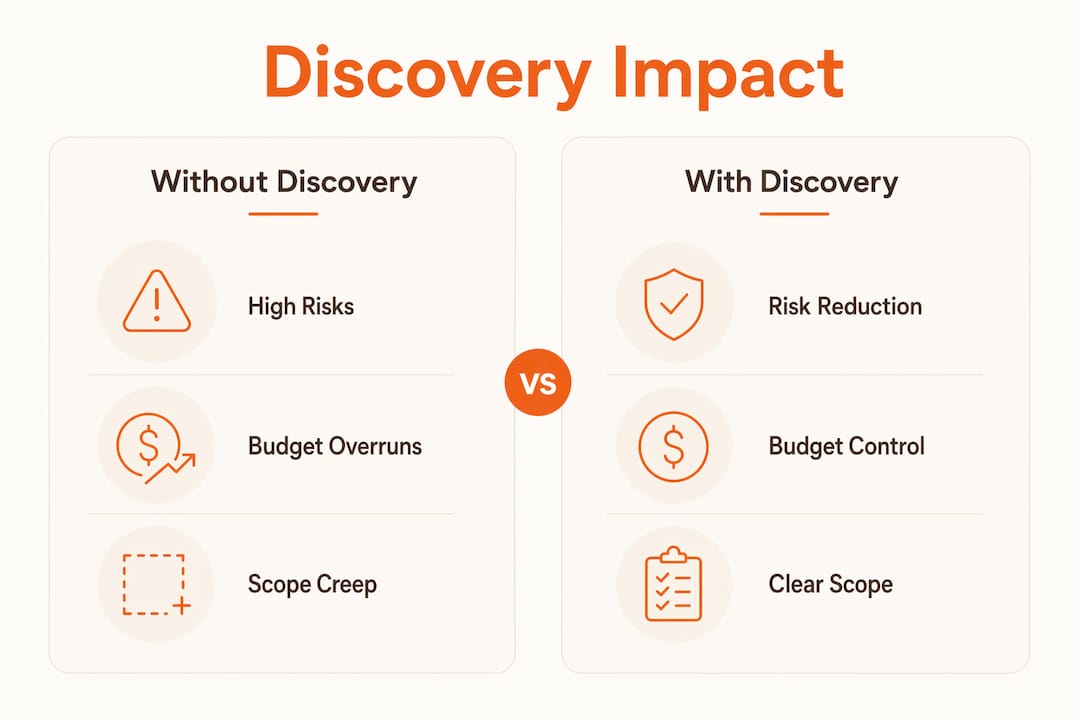
Discovery is also frequently structured as a separate fixed-fee contract, which protects both the client and the vendor. The client commits a defined amount to understand the full scope before signing a larger development agreement. The vendor avoids pricing unknown risk into the main contract. This structure is standard practice among experienced agencies and a strong signal of professional project management.
What practical methods and tools are used during discovery?
Discovery is not a single meeting or a questionnaire sent by email. It is a structured research process that draws on multiple methods to build a complete picture of the project. Workshops, stakeholder interviews, market research, SEO audits, analytics reviews, wireframing, and prototyping are the core methods used in professional discovery engagements.
The most common discovery tools and deliverables include:
- Stakeholder workshops. Facilitated sessions that surface conflicting priorities, align decision-makers, and document organizational goals. These are the fastest way to identify assumptions that would otherwise derail the project.
- Competitor analysis. A structured review of competing websites examining navigation, content structure, calls to action, and SEO positioning. Tools like Semrush and Ahrefs are commonly used for this work.
- SEO and analytics audits. Reviews of existing site performance using Google Analytics, Google Search Console, and crawl tools like Screaming Frog. These audits reveal what content is working, what is not, and where technical debt exists.
- User persona development. Research-backed profiles of the site’s primary audiences, including their goals, pain points, and decision-making behavior. Personas prevent the team from designing for an imaginary user.
- Wireframes and sitemaps. Low-fidelity structural documents that define page hierarchy and content layout before visual design begins. These are faster and cheaper to revise than finished designs.
- Risk registry and milestone plan. A documented list of identified project risks with mitigation strategies, paired with a timeline of key deliverables and approval gates.
Pro Tip:
Invite your internal subject matter experts to at least one discovery workshop, not just your marketing or IT leads. The people who handle customer service calls often know more about user pain points than anyone else in the organization.
Discovery outputs including scope definitions, user flows, architecture decisions, technology stack recommendations, and KPI frameworks give the project team a shared reference point throughout design and development. They also allow measurable success evaluation after launch, moving the definition of success beyond aesthetics and basic functionality.
How does discovery fit into the overall web design process?
A structured web design process typically follows eight steps from initial planning through post-launch optimization. Discovery is the first step and the one that shapes every step that follows. Understanding where discovery sits in the full lifecycle helps you plan resources and set realistic timelines.
The standard web design lifecycle looks like this:
| Phase | Primary outputs |
|---|---|
| Discovery | Scope document, personas, sitemap, risk registry, milestone plan |
| Design | Wireframes, visual mockups, design system, content framework |
| Development | Coded pages, CMS setup, integrations, database architecture |
| Testing | QA reports, browser compatibility checks, performance benchmarks |
| Launch | Deployment, DNS configuration, redirect mapping |
| Post-launch optimization | Analytics review, conversion rate testing, SEO monitoring |
Discovery outputs feed directly into the design phase. The sitemap defines what pages get designed. The personas define who the design serves. The technology stack recommendation defines what the development team builds on. Without these inputs, the design phase starts with guesswork.
The same outputs extend further. Risk registries inform QA testing priorities. KPI frameworks define what the analytics team monitors after launch. Milestone plans keep the project on schedule through development and testing. A well-structured web design process treats discovery not as a preliminary formality but as the document layer that holds the entire project together.
Projects that skip discovery do not eliminate this planning work. They defer it into the design and development phases, where changes cost far more to implement and far more time to resolve.
What are best practices and common pitfalls in web design discovery?
The difference between a discovery phase that delivers value and one that wastes time comes down to discipline and structure. Engaging key stakeholders early through workshops and interviews is the single most reliable predictor of a successful discovery outcome.
Best practices to follow:
- Allocate a minimum of two weeks for small projects. Shorter timelines produce incomplete scope documents that create problems in development.
- Involve all key stakeholders, including department heads, end users, and technical leads, not just the project sponsor.
- Document every finding in writing. Verbal agreements about scope and requirements become disputes when they are not recorded.
- Use structured frameworks for research. A consistent set of questions across stakeholder interviews produces comparable data rather than anecdotal impressions.
- Customize the discovery process to project size. A five-page small business website does not need the same discovery depth as a 200-page eCommerce platform.
Common pitfalls to avoid:
- Rushing discovery to reach design faster. This is the most expensive shortcut in web project management.
- Writing scope documents with ambiguous language. Phrases like “modern design” or “easy to use” are not measurable requirements.
- Ignoring existing user data. Analytics, heatmaps, and customer feedback from the current site are primary research sources that many teams overlook.
- Failing to connect business goals to design decisions. Discovery that documents user needs without tying them to revenue or conversion objectives produces websites that look good but underperform.
Improved communication and alignment among stakeholders is one of the most undervalued outcomes of a thorough discovery phase. When everyone on the project agrees on what success looks like before design begins, the entire project moves faster and with fewer conflicts.
Key takeaways:
The discovery phase is the highest-leverage investment in a web design project, returning five to ten times its cost by preventing scope creep, rework, and misaligned deliverables.
| Point | Details |
|---|---|
| Discovery defines scope first | Clear scope documents control budget variance to 10 to 20% versus 50 to 150% without discovery. |
| Four stages structure the work | Understanding, Designing, Validating, and Planning each serve a distinct purpose in the phase. |
| Discovery takes two to eight weeks | Timeline scales with project size; budget allocation runs five to eight percent of total project cost. |
| Outputs feed every downstream phase | Sitemaps, personas, risk registries, and KPI frameworks guide design, development, testing, and launch. |
| Skipping discovery defers cost | Unresolved planning work surfaces during development, where changes cost significantly more to implement. |
Why discovery is the most undervalued part of a web project.
I have worked on enough web projects to recognize a pattern. The clients who push back hardest on spending time in discovery are often the same clients who end up in difficult conversations about scope changes three months into development. It is not a coincidence.
Discovery gets undervalued because its output is documentation, not visible progress. There is no design to show a board of directors after two weeks of stakeholder interviews and competitive analysis. That invisibility makes it easy to cut when timelines feel tight or budgets feel constrained.
What I have found is that discovery does something beyond defining scope. It builds shared ownership of the project among stakeholders. When a department head has participated in a workshop and seen their input reflected in the sitemap, they are far less likely to introduce disruptive change requests later. That alignment is worth more than any individual deliverable the phase produces.
The other thing discovery does well is surface the real problem. Clients frequently come to a web project with a solution already in mind. They want a new homepage, a redesigned navigation, or a new content management system. Discovery often reveals that the actual problem is something different: unclear messaging, a broken user flow, or a mismatch between what the site offers and what users are searching for. Solving the right problem is worth far more than solving the stated problem efficiently.
Discovery is an investment in clarity. The projects that skip it do not save time. They spend it later, at a much higher rate.
How Expedition approaches discovery for your web project.
Expedition builds every web project on a structured discovery process that gives you clarity before a single design decision is made. Our Cincinnati-based team conducts stakeholder workshops, competitive analysis, SEO audits, and user research to define scope, identify risks, and align your project goals with measurable outcomes. The result is a custom marketing website built on research rather than assumptions, with a clear scope that protects your budget and timeline. If you are planning a new site or a strategy-driven redesign, discovery is where we start. Contact Expedition to learn how our process works and what it would look like for your project.
FAQ
What is the discovery phase in web design?
The discovery phase is the initial research and planning stage of a web design project where the team defines scope, gathers user and business requirements, and produces deliverables like sitemaps, personas, and risk registries. It runs before any design or development work begins.
How long does a web design discovery phase take?
Discovery typically lasts two to eight weeks depending on project size, with small projects requiring around two weeks and large projects requiring four to six weeks or more.
How much does the discovery phase cost?
Discovery is typically budgeted at five to eight percent of the total project cost and is often structured as a separate fixed-fee contract to protect both client and vendor before the main development agreement is signed.
What happens if you skip the discovery phase?
Projects that skip discovery face budget overruns of 50 to 150% due to uncontrolled scope changes and rework. The planning work does not disappear; it simply gets deferred into development where changes are far more expensive to implement.
What are the main deliverables from a web design discovery phase?
Discovery produces a scope definition, sitemap, user personas, user flows, technology stack recommendation, risk registry, milestone plan, and KPI framework. These outputs form the foundation for the design and development phases that follow.