Want to know how much your website project would cost?

Why Startups Need a Solid Brand Identity Before Website Development

Founder sketching brand ideas at desk

Brand identity is the strategic foundation that determines whether your website converts visitors or loses them within seconds. Before you write a single line of code or choose a WordPress theme, you need to know who you are, what you stand for, and how you communicate that to the people you want to serve. Founders who skip this step often build websites they have to rebuild within 18 months. The concept of a minimum viable brand, popularized by Shopify, gives you a practical framework to establish that foundation fast, without waiting for a perfect logo or a 40-page brand guide.

The core argument for why you need a solid brand identity before website development.

A brand is not your logo. It is the sum of every impression a customer forms about your business, from the words you use in a product description to the color of your call-to-action button. Founders who treat brand as a visual afterthought build websites that look fine but fail to communicate anything distinctive. That disconnect costs real money.

Startups who skip brand development before launch risk inconsistent messaging, lost customer trust, and a weaker online presence from day one. The website becomes a collection of pages rather than a persuasive system. Every redesign you do later to fix that problem costs more than getting it right before launch.

Recommended Image

The importance of branding for startups comes down to one practical reality: your website is a brand execution channel, not a brand creation tool. You cannot design your way into a clear identity. You have to define the identity first, then design around it.

What is a minimum viable brand and why does it matter?

The minimum viable brand, or MVB, is a concept Shopify defines as a pared-down brand identity with only the essential elements needed to launch, test, and improve based on customer feedback. Think of it as the branding equivalent of a minimum viable product. You ship the core, gather real data, and iterate from there.

An MVB typically includes four components:

  1. Logo. A clean, functional mark that works across digital and print contexts. It does not need to be perfect. It needs to be consistent.
  2. Color palette. Two to four colors that reflect your positioning. A fintech startup and a children’s toy brand should feel visually different before a visitor reads a single word.
  3. Messaging guidelines. A one-paragraph brand voice description, a positioning statement, and a clear value proposition. This is the most underbuilt element in most early-stage startups.
  4. Product or service description. Language that explains what you do, for whom, and why it matters. This copy feeds directly into your website’s homepage and landing pages.

The practical advantage of launching with an MVB is cost and flexibility. Rapid brand iteration with an MVB lowers initial costs compared to full-scale branding packages that often run into thousands of dollars. Tools like Canva let founders build initial logo concepts, color systems, and basic brand assets without a design agency. That does not mean Canva replaces professional brand work. It means you can test your positioning before you invest in the full build.
Pro Tip:

Before you hire a web designer, write a one-paragraph brand positioning statement: who you serve, what problem you solve, and what makes you different. If you cannot write that paragraph clearly, your website will not communicate it either.

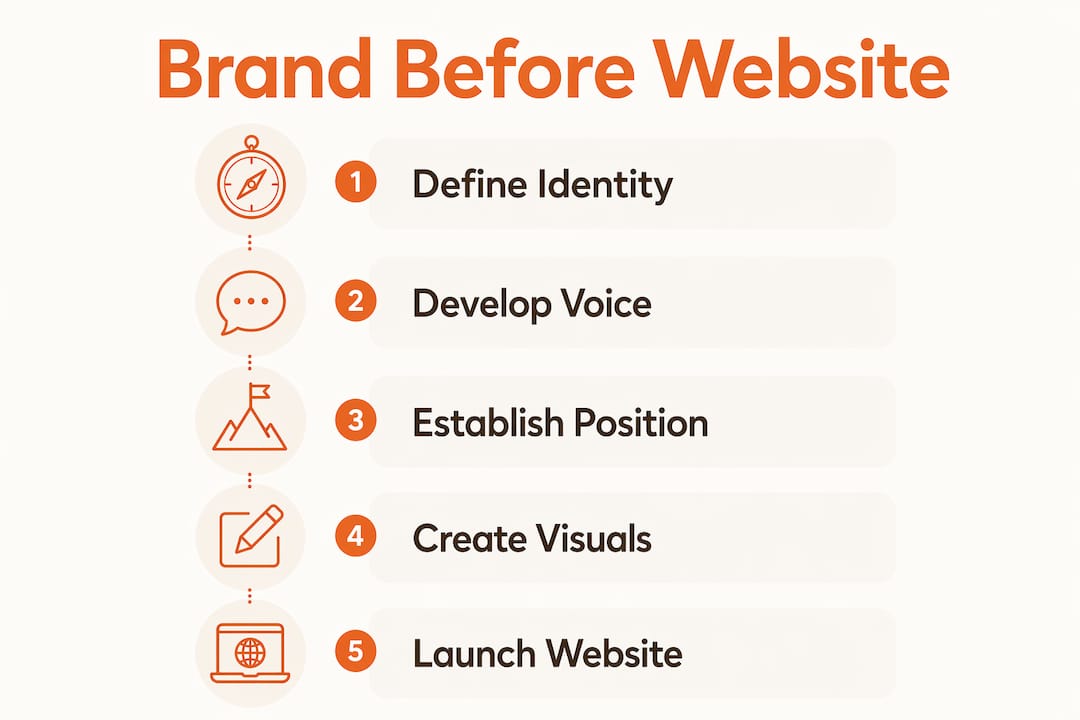
Infographic showing brand development steps before website launch

How consistent branding drives revenue and lowers marketing costs.

The data on brand consistency is specific and worth understanding before you build anything. Consistent brand presentation across all touchpoints, including your website, produces an average 23% revenue uplift. That figure comes from research tracking how brands that maintain visual and voice consistency across channels outperform those that do not. A 23% revenue lift is not a rounding error. For a startup projecting $500,000 in first-year revenue, that gap is $115,000.

The same research shows that inconsistent brands pay up to 1.75x more in media spend to achieve the same growth as consistent ones. That means a founder with a fragmented brand identity is essentially paying a tax on every marketing dollar they spend.

Here is how brand consistency and inconsistency compare across key business metrics:

MetricConsistent brandInconsistent brand
Revenue impact+23% average upliftBaseline or below
Media spend efficiencyStandard cost per acquisitionUp to 1.75x higher spend
Customer purchase probabilityIncreases with each consistent channelDrops with mixed signals
Trust and retentionHigher willingness to pay premiumLower repeat purchase rate

Brand voice consistency also affects purchase behavior directly. Each additional channel where a customer encounters a consistent brand experience increases their probability of purchasing by 90%. That means a founder who aligns their website, email, and social presence around the same voice and visual identity is compounding trust with every touchpoint.

“Brand consistency is not a design preference. It is a revenue strategy. Every inconsistency in how you present your business is a signal to potential customers that you are not sure who you are.”

The website is where most of this consistency either holds together or falls apart. A homepage that uses different language than your LinkedIn profile, or a color scheme that does not match your packaging, creates friction that customers feel even when they cannot name it.

Why your personal brand is your startup’s first brand asset.

For early-stage founders, the company brand often does not exist yet in any meaningful way. What does exist is your personal reputation, your network, and the trust you have built in your professional community. Founders’ personal brands frequently form the foundation for the company brand, using their credibility and relationships to accelerate customer acquisition before the product or service has established its own track record.

This is not a temporary workaround. It is a deliberate strategy with real advantages:

  • Trust transfer. Customers who trust you personally extend that trust to your business faster than they would to an anonymous brand.
  • Network leverage. Your existing professional relationships become early distribution channels before you have an SEO strategy or paid media budget.
  • Feedback access. People who know you will give you honest feedback on your positioning, messaging, and product in ways that strangers rarely will.
  • Content credibility. Founder-authored content, whether on LinkedIn, a podcast, or a blog, carries authority that generic company content does not.

The risk is over-reliance. A company brand that depends entirely on the founder’s personal identity becomes fragile as the business scales. The goal is alignment, not substitution. Your personal brand and your company brand should share values and voice, but the company brand needs to stand on its own as you grow.

Pro Tip:

Document the values, communication style, and positioning that define your personal brand before you build your company brand. The overlap between the two is often where your most authentic and differentiated brand voice lives.

How a strong brand strategy informs website design and content.

A clear brand strategy does not just make your website look better. It makes every design decision faster and more defensible. When you know your brand values, your target customer, and your positioning, you can answer questions like “should the homepage feel minimal or dense?” and “should we use photography or illustration?” without guessing.

Here is how brand clarity maps directly to website decisions:

Brand elementWebsite application
Brand voice and toneHomepage copy, product descriptions, CTA language
Color paletteButton colors, background treatments, accent use
TypographyHeading hierarchy, body text readability, brand personality
Positioning statementAbove-the-fold headline, meta descriptions, page titles
Customer segmentNavigation structure, content priority, imagery selection

Brands with clear identities experience fewer costly website redesigns and see stronger marketing ROI because every page was built with a defined purpose from the start. Without that clarity, web designers make aesthetic choices that may look good but do not serve your specific customer or communicate your specific value.

Website architecture, meaning how you organize pages, navigation, and content hierarchy, is a brand decision as much as a technical one. A B2B SaaS company and a local service business need fundamentally different site structures because their customers make decisions differently. That difference comes from brand strategy, not from web design trends.

The practical implication for founders is straightforward. Invest in brand identity design before you brief a web designer. Give your designer a brand guide, a positioning statement, and a clear description of your customer. You will get a better website in less time, with fewer revision rounds, and at a lower total cost.

Key takeaways:

Brand must precede website because every design, copy, and architecture decision on your site flows from a defined brand identity, and without it, you build a site you will have to rebuild.

PointDetails
Brand before websiteDefine your identity, voice, and positioning before any web design work begins.
Use the MVB frameworkLaunch with logo, color palette, messaging, and product description to test fast and iterate.
Consistency drives revenueConsistent brand presentation produces a 23% average revenue uplift and cuts media waste by up to 1.75x.
Founder brand is a head startYour personal credibility and network are your startup’s first brand assets. Use them deliberately.
Brand clarity cuts design costsFounders with clear brand strategy experience fewer redesigns and stronger marketing ROI from launch.
From the Founder:

The case for doing this in the right order.

I have worked with enough founders to recognize a pattern. The ones who launch a website first and figure out their brand later almost always come back for a redesign within two years. Not because the original site was ugly, but because it was built without a clear point of view. The pages look fine individually, but they do not add up to anything coherent.

The founders who take even two or three weeks to define their positioning, nail their voice, and build a basic visual system before touching a website brief get dramatically better results. Their designers ask fewer questions. Their copywriters need fewer revisions. Their first site actually converts because every element was built toward the same goal.

The MVB approach is what I recommend to founders who are worried about speed. You do not need a 60-page brand guide before you launch. You need a clear positioning statement, a consistent visual system, and a voice that sounds like a real company with a real point of view. That work takes days, not months, and it pays for itself the first time a potential customer lands on your site and immediately understands what you do and why it matters.

Brand is not a luxury you add after you have revenue. It is the infrastructure that helps you get there.

- Bradley Givens, Co-Founder & Creative Director

How Expedition helps startups build brand first.

At Expedition, we organize our work around four pillars: Brand, Build, Market, and Maintain. That order is intentional. Brand comes first because everything we build in the web design phase depends on having a clear identity to execute against. Our Cincinnati-based team handles brand identity design and custom website design under one roof, which means the same people who define your brand are the ones who build your site. Nothing gets lost in translation between a branding agency and a web team. If you are a founder ready to build something that works from day one, we would be glad to walk you through how we approach it.

FAQ

What is a minimum viable brand for a startup?

A minimum viable brand is a lean set of core brand elements, including a logo, color palette, messaging guidelines, and product description, that allows founders to launch and test their brand before investing in a full website or campaign. Shopify defines it as the branding equivalent of a minimum viable product.

Is brand more important than a website for early-stage founders?

Brand strategy is the prerequisite for an effective website, not a competitor to it. Without a defined brand identity, website design defaults to aesthetic guesswork, which produces sites that look acceptable but fail to convert or communicate a clear value proposition.

How does brand consistency affect startup revenue?

Consistent brand presentation produces an average 23% revenue uplift and reduces media spend by up to 1.75x compared to inconsistent brands. Each additional channel where customers encounter a consistent brand increases their purchase probability by 90%.

How long does it take to build a minimum viable brand?

A functional MVB, covering logo, colors, voice, and positioning, can be completed in one to three weeks depending on the founder’s clarity on their customer and value proposition. Tools like Canva accelerate the visual side, while the messaging work requires focused strategic thinking.

Can a founder’s personal brand substitute for a company brand?

A founder’s personal brand accelerates early trust and customer acquisition, but it cannot permanently substitute for a company brand. The goal is alignment between the two, with the company brand developing its own identity as the business scales beyond the founder’s direct involvement.

In this article:

Get an estimate for your website project in minutes.

Customize your website estimate by answering a few quick questions. Get instant pricing with no commitment.

No email required!

Continue Reading

Team in web design discovery meeting

The Benefits of Integrated Design and Development Services

Read More
Founder sketching brand ideas at desk

In-House Hire vs. Outsourcing Design and Development: Making The Right Choice

Read More
Woman browsing ecommerce on smartphone at home

Responsive Web Design: Why Is It Important?

Read More