A website is the single most important digital asset a small business can own, directly determining whether potential customers find you, trust you, and contact you. Most small business owners underestimate how much revenue they lose without one. Understanding why a website matters for small business success is not a theoretical exercise. It is a practical, measurable business decision with a clear financial return.
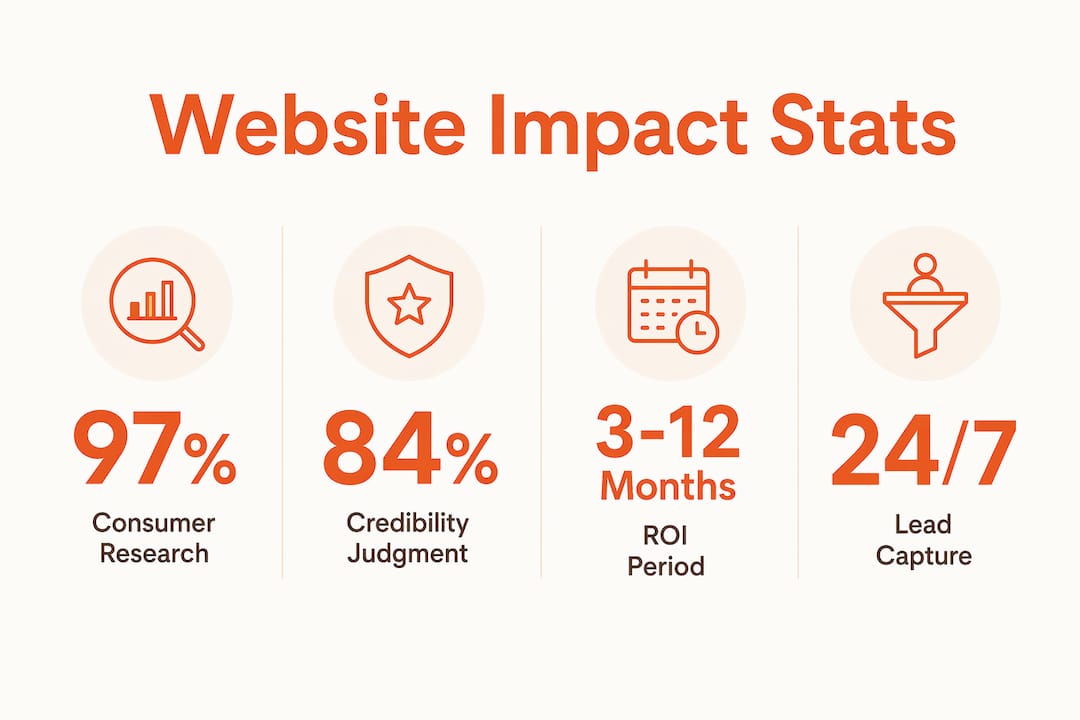
97% of consumers research businesses online before making a purchase or visiting in person. That number alone reframes the question. If your business is not findable online, the majority of your potential customers are already choosing someone else.
Why a website matters for small business visibility.
Discoverability is the first problem a website solves. When someone searches “plumber near me” or “best bakery in Cincinnati,” Google returns a ranked list of local businesses. Businesses with websites consistently outrank those without them because Google prioritizes linked websites in local search results for relevance and authority. A Google Business Profile helps, but it performs significantly better when connected to a real website.

Social media profiles do not fill this gap. A Facebook page or Instagram account does not rank competitively for local search queries the way a properly built website does. Search engine optimization, or SEO, requires a website with indexable pages, structured content, and technical signals that social platforms simply cannot provide. If you want to show up when customers are actively searching for what you sell, a website is the mechanism that makes that possible.
Here is what the data shows about small business online presence and search behavior:
- Businesses without websites lose 70 to 80% of potential customers to competitors who do have one.
- Small businesses with websites grow revenue 40% faster than those without.
- 27% of U.S. small businesses still lack a website, meaning the opportunity to outrank local competitors is real and available right now.
- A Google Business Profile paired with a website improves both local search rankings and customer engagement measurably.
The compounding effect matters here. Well-optimized website content builds authority over time, continuously attracting organic traffic long after the content is published. A social media post disappears from feeds within hours. A well-written service page can generate leads for years.
Does a website actually build credibility?
Yes, and faster than most business owners expect. 84% of consumers judge a business’s credibility by the quality of its website, and that judgment happens in 0.05 seconds. That is not a figure to dismiss. It means a visitor forms an opinion about your business before they have read a single word on your page.
75% of consumers admit they judge a business’s professionalism based on website design rather than social media presence. A poorly designed website, or no website at all, signals unprofessionalism regardless of how good your actual service is. Businesses with websites are 2.8 times more likely to be perceived as reputable compared to those relying solely on social media.
Your website is also the only place where you control the complete brand narrative. Consider what a website can do that a social media profile cannot:
- Display detailed service descriptions with pricing context and process explanations
- Feature verified customer testimonials and case study results
- Present professional photography, brand colors, and typography consistently
- Publish original content that demonstrates expertise and builds authority
- Provide a secure, distraction-free environment for a customer to make a decision
Social media has real value, but it is not a substitute for the trust signals a professional website delivers. Customers who are ready to spend money want to see a real business with a real web presence before they pick up the phone.
How websites work as 24/7 lead generation tools.
A website does not clock out. It captures leads, answers questions, and books appointments at 2 a.m. on a Sunday with no staff involvement. 30 to 50% of customer inquiries happen outside standard business hours, and a website is the only tool that handles those interactions automatically.
The conversion numbers are concrete. A website with a standard contact form converts visitors at 2 to 3%. Add an AI chatbot or live chat tool, and conversion rates climb to 10 to 15%. That difference compounds quickly when you consider monthly traffic volume. A local service business generating 500 monthly visitors could see 15 to 75 leads per month from the website alone, depending on the tools in place.
Here is a practical sequence for turning a website into a lead generation engine:
- Add a contact form to every service page. Do not make visitors hunt for a way to reach you.
- Include a direct phone number and email in the header. Friction kills conversions.
- Set up a booking tool like Calendly or Acuity Scheduling so customers can schedule without a phone call.
- Install a chatbot or live chat widget to handle common questions and capture contact details after hours.
- Create a clear call to action on the homepage that tells visitors exactly what to do next.

Pro Tip:
The most common website mistake small businesses make is burying the contact information. Your phone number should be visible without scrolling on every page, especially on mobile. If a customer has to search for how to reach you, most of them will not bother.
Websites pay for their initial investment within 3 to 12 months through lead capture and automation for most small businesses. That payback period shortens significantly when the site is built with lead generation as the primary goal rather than aesthetics alone.
What features does a small business website actually need?
Not every website feature matters equally. The goal is a site that converts visitors into customers, not one that wins design awards. These are the elements that directly affect whether a visitor contacts you or leaves:
- Business name, location, and phone number visible in the header on every page. This is non-negotiable for local businesses.
- Mobile-friendly design. More than half of web traffic comes from mobile devices. A site that does not work on a phone loses those visitors immediately.
- SSL certificate (HTTPS). Google flags non-secure sites, and customers notice the warning. Security is a baseline expectation.
- Fast load speed. Pages that take more than three seconds to load see significantly higher bounce rates. Speed is both a user experience issue and an SEO factor.
- Service pages with real detail. Vague descriptions do not convert. Explain what you do, who you serve, what the process looks like, and what results customers can expect.
- Customer testimonials or reviews. Social proof on the page itself, not just on Google, reinforces credibility at the moment of decision.
- Clear calls to action. Every page should tell the visitor what to do next: call, book, request a quote, or fill out a form.
For a deeper look at which pages belong on a small business site, essential website pages covers the structure that converts. The difference between a site that generates leads and one that just exists online often comes down to these structural decisions made before a single word is written.
Why owning your website beats relying on social media.
Owning a website means full control over your content, branding, and customer data. Social media platforms control all three on your behalf, and they change the rules without notice. Organic reach for business pages on major social platforms has declined to 2 to 5%, meaning fewer than 1 in 20 of your followers see any given post without paid promotion.
The risk is not hypothetical. Platforms change algorithms, reduce organic reach, alter business features, or shut down accounts. Businesses that built their entire customer acquisition strategy on a single social platform have lost that audience overnight when policies changed. A website is a durable digital asset that maintains your access to customers regardless of what any platform decides to do.
Pro Tip:
Use social media to drive traffic to your website, not as a replacement for it. Post content that links back to your service pages, blog posts, or contact form. This way, social media amplifies your website rather than competing with it.
The most effective small business marketing strategy treats the website as the central hub. Paid ads, social media posts, email campaigns, and Google Business Profile listings all point back to the website, where the actual conversion happens. A conversion-optimized website turns that traffic into leads and revenue. Without it, you are paying to send customers to a dead end.
Key takeaways:
A professional website is the most cost-effective customer acquisition tool a small business can invest in, delivering visibility, credibility, and lead generation that no social media profile can replicate.
| Point | Details |
|---|---|
| Visibility through search | 97% of consumers research online first; websites rank in local search where social profiles cannot. |
| Credibility on first impression | 84% of consumers judge business credibility by website quality, formed in 0.05 seconds. |
| 24/7 lead generation | 30 to 50% of inquiries happen after hours; websites capture leads automatically without staff. |
| Ownership and control | You own your website content and data; social platforms control reach and can change access at any time. |
| ROI within months | A professional website typically pays for itself within 3 to 12 months through new customer leads. |
What I have learned from watching small businesses launch websites.
I have seen the before and after enough times to say this with confidence: the businesses that treat a website as an expense are the ones who get the least from it. The ones who treat it as a sales tool, built with a clear customer journey in mind, are the ones who call us six months later to talk about adding more capacity because the leads are coming in.
The most common misconception I encounter is that social media is enough. It is not, and the data backs that up clearly. But beyond the data, there is a practical reality: social media is where people scroll. A website is where people decide. Those are two very different moments in the customer journey, and only one of them reliably produces revenue.
The other thing worth saying directly: a professional website does not have to be expensive to be effective. Website costs for small businesses range from $1,200 to $5,000 for a professionally built site, and that investment pays for itself through new leads within a matter of months for most service businesses. The question is not whether you can afford a website. It is whether you can afford to keep operating without one.
How Expedition builds websites that work for small businesses.
Expedition designs and builds small business websites starting at $4,500, with every project handled in-house by a U.S.-based team in Cincinnati, Ohio. The work is strategy-driven from the start, meaning the site is built to generate leads and convert visitors, not just to look good. Every site includes SEO foundations, mobile-optimized design, and clear conversion paths built in from day one. Expedition also handles ongoing website maintenance and SEO services, so your site stays secure, current, and performing long after launch. If you are ready to turn your website into your best sales tool, Expedition is the team to build it.
FAQ
Why does a website matter more than a social media page?
A website gives you full control over your content, branding, and customer data, while social media platforms control your reach and can change access at any time. Social media organic reach has declined to 2 to 5%, making it an unreliable primary channel for customer acquisition.
How quickly can a small business website generate leads?
Most small business websites pay for their initial investment within 3 to 12 months through lead capture and automation. Sites with contact forms convert at 2 to 3%, and adding a chatbot can push that figure to 10 to 15%.
Does my small business need a website if I already have a Google Business Profile?
Yes. A Google Business Profile performs significantly better in local search when linked to a real website. Google ranks businesses with verified websites higher than those without one, making the two tools complementary rather than interchangeable.
How much does a small business website cost?
A professionally built small business website typically ranges from $1,200 to $5,000 depending on scope, features, and the agency you work with. That investment generally returns its cost within months through new customer leads and revenue.
What is the most important feature of a small business website?
Clear contact information and a strong call to action on every page are the most critical features for lead generation. A site that does not make it easy for visitors to reach you immediately loses the majority of potential customers before they ever make contact.