If you run an online store and wonder what does ecommerce SEO mean beyond basic keyword stuffing, you are not alone. Most business owners hear “SEO” and picture someone dropping search terms into product descriptions. The reality is far more layered. Ecommerce SEO means optimizing your entire online store so product and category pages earn visibility in search results for searches where people are ready to buy. It covers technical structure, on-page content, and off-page authority, all working together to bring high-intent shoppers to your site without paying for every click.
Key takeaways:
| Point | Details |
|---|---|
| Ecommerce SEO is multi-layered | It combines technical SEO, on-page optimization, and off-page authority building across your entire store. |
| Category pages are your biggest asset | Optimizing category pages for broad, high-volume queries drives more organic traffic than product pages alone. |
| SEO is never a one-time task | Ongoing audits, content updates, and technical fixes are required to sustain and grow organic rankings. |
| Buyer intent drives keyword strategy | Targeting transactional and commercial-intent keywords brings shoppers who are closer to purchasing. |
| User experience and SEO are linked | Sites that are fast, mobile-friendly, and easy to navigate rank better and convert more visitors. |


What ecommerce SEO means and how it works
The ecommerce SEO definition comes down to this: it is the practice of making your online store easy for search engines to find, understand, and rank for searches that lead to purchases. That is the core meaning of ecommerce SEO, and it separates it from general website optimization. You are not just trying to get traffic. You are trying to get the right traffic from people who are already looking for what you sell.
Understanding ecommerce SEO means recognizing three distinct layers that work together.
Technical SEO is the foundation. It covers how search engines crawl and index your site. For an ecommerce store, this includes your URL structure, site speed, mobile usability, duplicate content from filter pages, and XML sitemaps. If Google cannot efficiently crawl your store, your product pages will not rank regardless of how well-written they are.
On-page SEO is everything that happens on the page itself. This includes:
- Product titles that include the terms shoppers actually search for
- Unique product descriptions that go beyond manufacturer copy
- Optimized image alt text so Google understands your visuals
- Clean, descriptive URLs like /mens-running-shoes/ rather than /product?id=4829
- Meta titles and descriptions that earn clicks in search results
Off-page SEO builds your store’s authority in Google’s eyes. Backlinks from relevant, trusted websites signal that your store is credible. For ecommerce, this often comes from product reviews on industry blogs, supplier mentions, and press coverage.
How ecommerce SEO differs from general SEO
Most SEO guides are written with blogs or service websites in mind. Ecommerce SEO operates at a completely different scale. A typical blog might have 50 pages. An ecommerce store can have thousands of product URLs, dozens of category pages, and hundreds of filter combinations that each generate a unique URL.
Here is a direct comparison to make the differences clear:
| Factor | General SEO | Ecommerce SEO |
|---|---|---|
| Page volume | Tens to hundreds of pages | Hundreds to thousands of product and category pages |
| Primary ranking assets | Blog posts and service pages | Category pages and product pages |
| Keyword focus | Informational and navigational | Transactional and commercial intent |
| Technical complexity | Moderate | High, due to faceted navigation and dynamic URLs |
| Content updates | Periodic blog publishing | Continuous product and inventory changes |
| Conversion goal | Lead generation or brand awareness | Direct product sales |
Category pages are primary ranking assets in ecommerce SEO, often more valuable than individual product pages for targeting broader, higher-volume queries. Think about it this way: a shopper searching “women’s waterproof hiking boots” is not yet sure which specific product they want. Your category page for waterproof hiking boots is the right landing point for that search. It serves as the entry into the buying journey, and it targets a query that gets far more monthly searches than any single product name.

The other major difference is the ongoing maintenance requirement. Ecommerce SEO demands continuous optimization across hundreds of pages, mobile usability, internal linking, and page speed. Products go out of stock. New collections launch. Seasonal categories need updating. Each of these changes has SEO implications that a static website simply does not face.
Strategies that actually move the needle
Knowing the ecommerce SEO basics is one thing. Executing them consistently is another. Here are the strategies that produce real results for online retailers.
- Map keywords to buyer intent. Effective ecommerce keywords include both short-tail and long-tail terms with commercial intent, bringing higher conversion potential. Start with your category pages and identify the broadest transactional queries they should rank for. Then work down to product-level keywords that match specific searches.
- Optimize category pages first. Most store owners spend all their SEO effort on product pages and ignore categories. Write a unique introductory paragraph for each category page that includes the primary keyword naturally. Add internal links to subcategories and featured products. This signals topical depth to search engines.
- Fix technical issues before adding content. Crawl errors, slow page speed, and poor mobile usability can significantly harm ecommerce SEO rankings regardless of product quality. Use Google Search Console to identify crawl errors. Run a page speed test on your top category pages. Address these before investing in content creation.
- Implement structured data markup. Product schema must align precisely with live page details like price and availability to enable eligibility for rich results. Rich results show star ratings, price, and stock status directly in search listings, which increases click-through rates significantly.
- Build a smart internal linking structure. Link from blog content and category pages down to individual products. Link from product pages back up to their parent categories. This distributes page authority throughout your store and helps Google understand your site’s hierarchy.
- Monitor and adapt continuously. Treating ecommerce SEO as ongoing work with regular maintenance and adaptation is critical for long-term success. Schedule monthly reviews of your top-ranking pages, quarterly technical audits, and seasonal content updates tied to your product calendar.
Common mistakes that stall ecommerce SEO growth.
Even business owners who understand the importance of ecommerce SEO often fall into the same traps. Knowing what to avoid is just as valuable as knowing what to do.
- Treating SEO as a one-time setup. This is the most common mistake. You optimize your store at launch and expect rankings to hold indefinitely. They will not. Regular audits, indexing fixes, and content updates are what sustain SEO growth over time.
- Ignoring category pages entirely. Many store owners focus exclusively on product descriptions and wonder why their organic traffic is flat. Category pages are often underutilized yet serve as powerful ranking assets targeting broader buyer intent.
- Relying entirely on paid ads. Paid traffic stops the moment you stop paying. Organic traffic compounds over time. A well-optimized store generates free, consistent traffic that does not disappear when your ad budget runs out.
- Neglecting mobile and technical SEO. A slow site or one that renders poorly on a phone will lose rankings. Google uses mobile-first indexing, meaning it primarily evaluates the mobile version of your site.
- Misaligned or missing product schema. Structured data that does not match the live page state, such as showing a price that differs from the actual product price, can disqualify your pages from rich results and erode search engine trust.
- Separating SEO from user experience. Successful ecommerce SEO blends best practices with user experience improvements to convert searchers effectively. Rankings get people to your store. A clear, fast, and easy-to-use site is what turns them into customers.
Measuring ecommerce SEO success.
You cannot improve what you do not measure. Once you have implemented the ecommerce SEO basics, tracking the right metrics tells you whether your efforts are working.
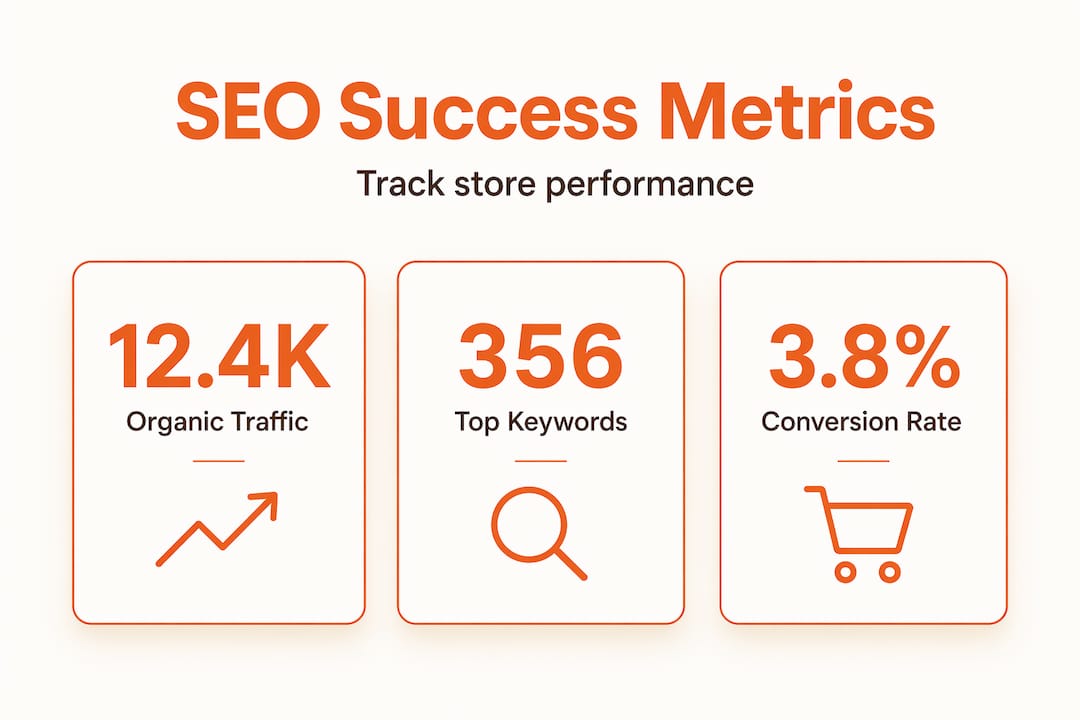
| Metric | What it tells you | Where to track it |
|---|---|---|
| Organic traffic | How many visitors arrive via search engines | Google Analytics |
| Keyword rankings | Which queries your pages rank for and at what position | Google Search Console |
| Click-through rate (CTR) | How often searchers click your listing vs. seeing it | Google Search Console |
| Organic conversion rate | How many organic visitors complete a purchase | Google Analytics |
| Crawl errors | Pages Google cannot access or index properly | Google Search Console |
| Core Web Vitals | Page speed and user experience scores | Google Search Console / PageSpeed Insights |
Start with Google Search Console. It is free and gives you direct data from Google about how your store appears in search. Pair it with Google Analytics to connect traffic data with actual sales. For keyword tracking and technical audits, tools like Ahrefs or Semrush provide deeper insight into where your rankings stand relative to competitors.
When to bring in professional help is a fair question. If your store has more than 200 product SKUs, a growing catalog, or you are spending significant money on paid ads without a parallel organic strategy, working with an experienced SEO team is worth the investment. The complexity of managing technical SEO at scale while running a business is real.