Want to know how much your website project would cost?

How to Choose a Web Designer for Your Business

Business owner reviewing web designer portfolio

Choosing a web designer means finding a professional who builds a site that works for your business, not just one that looks good. The right designer understands your goals, follows a structured process, and delivers a site that generates leads or sales. The wrong one leaves you with a pretty page that underperforms. This guide walks you through how to choose a web designer by evaluating process, portfolio quality, pricing, and long-term support before you sign anything.

How to choose a web designer: start with your website’s purpose.

The single most important step happens before you contact anyone. You need to define what your website must accomplish. A brochure site for a local law firm requires different skills than a WooCommerce store processing hundreds of orders per month or a booking platform for a medical practice.

Vague requests like “I need a website” make it nearly impossible to screen candidates fairly. A clear brief describing specific functions, such as online payments, appointment booking, or lead capture forms, helps you match designer expertise to your actual needs. It also gives you a baseline to compare proposals on equal terms.

Before reaching out to any designer, get clear on these points:

  • Website type: Brochure, eCommerce, booking platform, or membership site
  • Primary goal: Lead generation, direct sales, brand awareness, or customer support
  • Success criteria: What does a win look like in 6 months? More calls, more orders, lower bounce rate?
  • Content readiness: Do you have copy, photos, and brand assets ready, or does the designer need to handle that?
  • Timeline and budget: A realistic range, not just “as cheap as possible”

Pro Tip:

Write a one-page project brief before your first call with any designer. It forces clarity on your end and immediately shows you which candidates read it carefully and which ones send a generic response.

Content readiness deserves special attention. Content delivery is the number one reason web projects run late. If you cannot provide copy and photos on schedule, build that buffer into your timeline upfront.

What to look for in a web designer’s portfolio.

Most business owners evaluate portfolios by scrolling through screenshots. That approach misses the most important signals. Screenshots tell you nothing about how a site performs on a phone, whether the contact form works, or how fast the page loads.

Checking live URLs and testing actual functionality is the single best filter to separate competent designers from those who rely on aesthetics alone. When you visit a designer’s portfolio sites, test these things directly:

  • Mobile responsiveness: Does the site reformat cleanly on a phone, or do elements overlap?
  • Navigation: Are menus logical and easy to use on every device?
  • Forms and calls to action: Do contact forms submit correctly? Are buttons prominent and functional?
  • Page speed: Does the site load in under three seconds on a standard connection?
  • Content quality: Is the copy clear and professional, or does it read like a template?

Technical deficiencies hidden behind polished screenshots become your problem after launch. Poor technical build quality often requires a costly rebuild within one to two years. Catching it during evaluation costs you nothing.

Pro Tip:

Pull up a portfolio site on your own phone during the discovery call. If the designer built it and cannot explain why it looks broken on mobile, that tells you everything you need to know.

Also verify platform expertise. A designer who specializes in WordPress should demonstrate real command of that CMS, including plugin management, theme customization, and performance tuning. A Shopify specialist should show eCommerce stores with working product pages and checkout flows. Platform familiarity directly affects how maintainable your site will be after launch.

Web designer testing website on smartphone

Does the designer follow a structured delivery process?

A structured process is the clearest indicator of a professional web designer. Evaluating a web designer should focus on their delivery process, not just portfolio aesthetics. A reliable process reduces your risk and creates accountability at every stage.

Ask every candidate to walk you through their standard project phases. A professional process covers these stages in order:

  1. Discovery: Understanding your business, audience, competitors, and goals
  2. Planning: Sitemap, wireframes, content structure, and technical requirements
  3. Design: Visual mockups with defined review and approval rounds
  4. Development: Building the site on the chosen platform with clean, maintainable code
  5. Testing and QA: Cross-browser testing, mobile testing, form testing, and speed checks
  6. Launch: Controlled go-live with DNS management and final checks
  7. Post-launch support: A defined period of bug fixes and adjustments after the site goes live

Compare how candidates describe their process using this framework:

StageWhat a strong candidate saysWhat a weak candidate says
Discovery“We start with a structured intake to map your goals and audience.”“We can start building right away.”
Review rounds“You get two design revision rounds before development.”“We revise until you’re happy.”
Testing“We test on iOS, Android, Chrome, Safari, and Firefox.”“We check it before we send it over.”
Post-launch“We include 30 days of support after launch.”“Let us know if anything comes up.”

Written proposals should spell out each phase, milestone, and review stage explicitly. If a proposal skips testing or post-launch support, those gaps will cost you later. Ongoing website maintenance after launch is not optional. Security updates, plugin patches, and performance monitoring keep your site functional and protected.
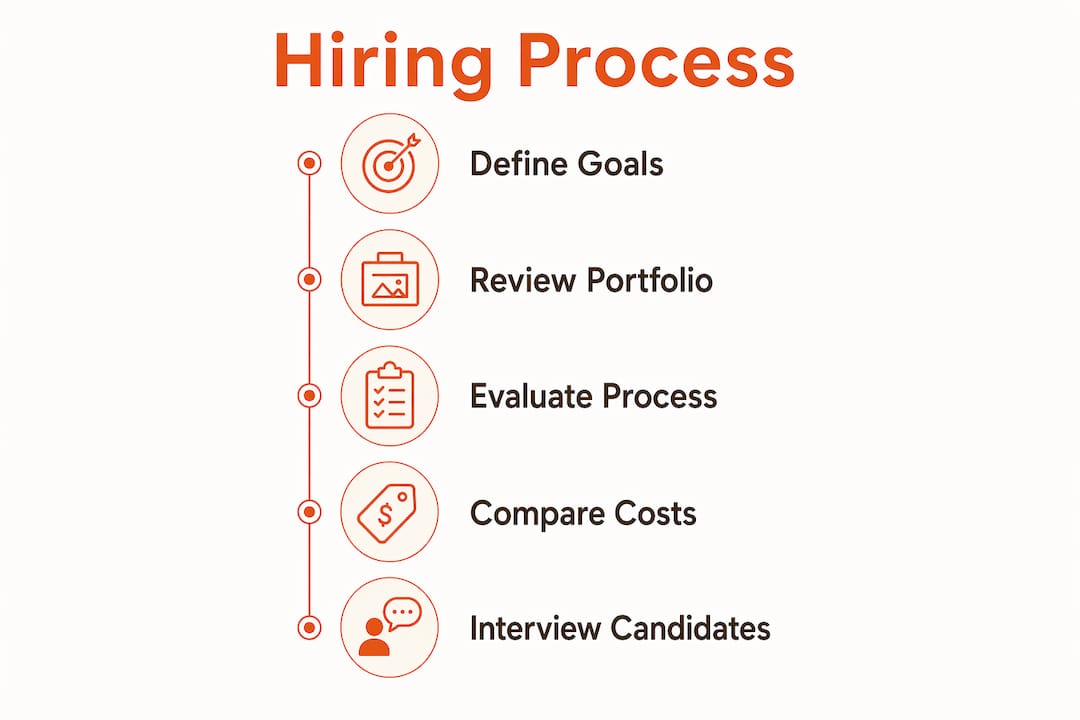
Infographic showing steps to hire web designer

How to compare web design costs without getting burned.

Price is the most misunderstood factor when selecting a web designer. The lowest quote rarely represents the best value. Cheaper options frequently omit testing, security updates, and post-launch support, which increases your total cost over time.

To understand web design pricing and compare proposals fairly, you need to evaluate what each quote actually includes. Use these criteria:

  • Deliverables: Does the quote include design, development, content migration, and testing, or just design?
  • Revision rounds: How many rounds of changes are included before additional fees apply?
  • Platform and hosting: Is the CMS setup included? Who owns the hosting account?
  • SEO foundation: Does the build include basic on-page SEO, meta tags, and site speed optimization?
  • Post-launch support: Is there a defined support window, or does the relationship end at launch?
  • Maintenance plan: Is ongoing maintenance offered, and at what cost?

Comparing proposals against the same deliverables is the only way to make a reliable decision. A $3,000 quote that excludes testing and post-launch support is not cheaper than a $6,000 quote that includes both. It is just a different product.

Budget constraints are real, and a good designer will work within them honestly. The goal is to find the best value at your price point, not the lowest number on a spreadsheet.

Practical tips for interviewing and hiring a web designer.

The interview stage is where most business owners make their biggest mistakes. They evaluate designers on personality and portfolio alone, skipping the questions that reveal process maturity and communication quality.

Using a structured questionnaire or a short test brief dramatically improves evaluation quality. Send every candidate the same one-page brief describing your project and ask them to respond with their approach. The responses reveal who read it carefully and who sent a recycled pitch.

Watch for these qualities beyond the portfolio:

  • Problem understanding: Does the designer ask clarifying questions, or do they jump straight to solutions?
  • Communication style: Do they explain technical concepts clearly, or do they hide behind jargon?
  • Platform knowledge: Can they speak specifically about WordPress, WooCommerce, or whatever CMS fits your project?
  • Timeline realism: Do they give you a realistic schedule, or do they promise whatever you want to hear?

Pro Tip:

Ask every candidate: “What is the most common reason your projects run late?” A confident, honest answer reveals process maturity. Deflection or blame-shifting reveals a red flag.

Red flags to watch for include: no defined revision process, vague post-launch support, inability to show live portfolio URLs, and pressure to decide quickly. For businesses weighing the freelancer vs. agency decision, the right choice depends on project complexity. Freelancers suit smaller, well-defined projects. Agencies with structured teams suit complex builds requiring strategy, design, development, and ongoing support under one roof.

Content and approval workflows also matter. Agree upfront on who provides copy, who approves designs, and how long each approval round takes. Delays on your end cost you just as much as delays on theirs.

Key Takeaways:

Choosing the right web designer requires defining your project clearly, validating portfolios with live sites, and comparing proposals on process and deliverables, not price alone.

PointDetails
Define your goals firstWrite a one-page brief before contacting any designer to filter candidates effectively.
Validate portfolios with live URLsTest mobile responsiveness, forms, and page speed on actual live sites, not screenshots.
Require a structured processConfirm the designer covers discovery, testing, launch, and post-launch support in writing.
Compare proposals on equal termsEvaluate quotes against identical deliverables, including testing and maintenance, not just price.
Screen with structured questionsUse a test brief and direct questions to assess communication, problem understanding, and platform expertise.
From the Founder:

What I’ve learned from watching web projects go sideways.

The most common mistake I see business owners make is treating the web design decision like a commodity purchase. They collect three quotes, pick the middle price, and assume the work will be roughly equivalent. It rarely is.

The gap between a designer who follows a structured process and one who does not shows up six months after launch. The structured designer delivers a site that loads fast, converts visitors, and requires minimal emergency fixes. The other one delivers something that looks fine in a browser window and falls apart under real traffic.

Live portfolio validation changed how I evaluate designers entirely. I stopped looking at screenshots years ago. The moment you pull up a portfolio site on your phone and find broken navigation or a contact form that does not submit, you have learned more than any sales call could tell you.

The other thing most guides undervalue is post-launch support. Business owners sign off on a site, pay the final invoice, and assume the relationship is done. Then a plugin update breaks the checkout page three months later, and they have no one to call. Post-launch maintenance is not an upsell. It is a structural requirement for any site that handles real business traffic.

Process maturity matched to project complexity is the clearest predictor of a successful outcome. A solo freelancer can be excellent for a five-page brochure site. A complex eCommerce build with custom integrations needs a team with defined roles and a repeatable process. Matching those two things correctly is the decision that actually matters.

- Bradley Givens, Co-Founder & Creative Director

Expedition builds sites that work for your business.

Expedition is a Cincinnati-based web design agency that builds small business websites starting at $4,500, with custom WordPress sites and strategy-driven redesigns handled entirely by a U.S.-based in-house team. Every project follows a defined process covering discovery, design, development, testing, and post-launch support. Expedition also handles SEO, conversion rate optimization, and ongoing maintenance, so you work with one team from build through growth. Contracts are month-to-month with no onboarding fees, and Expedition price-matches existing scopes when you move over from another provider. If you are ready to work with a team that treats your website as a business tool, contact Expedition to start the conversation.

FAQ

What is the most important factor when selecting a web designer?

The most important factor is the designer’s delivery process. A structured process covering discovery, design, testing, and post-launch support reduces risk and produces better long-term results than aesthetics alone.

How do I verify a web designer’s portfolio quality?

Visit every portfolio site on your phone and test navigation, forms, and page speed directly. Screenshots do not reveal mobile responsiveness or technical build quality.

How much should a small business website cost?

Small business website costs vary widely based on scope, platform, and deliverables included. Expedition’s small business websites start at $4,500, and a detailed website cost guide can help you understand what drives pricing.

Should I hire a freelancer or a web design agency?

Freelancers suit smaller, well-defined projects with lower budgets. Agencies are better for complex builds requiring strategy, design, development, and ongoing support from a coordinated team.

What red flags should I watch for when hiring a web designer?

Watch for designers who cannot show live portfolio URLs, skip testing in their process, offer vague post-launch support, or pressure you to decide quickly without a written proposal.

In this article:

Get an estimate for your website project in minutes.

Customize your website estimate by answering a few quick questions. Get instant pricing with no commitment.

No email required!

Continue Reading

Team in web design discovery meeting

The Benefits of Integrated Design and Development Services

Read More
Founder sketching brand ideas at desk

In-House Hire vs. Outsourcing Design and Development: Making The Right Choice

Read More
Woman browsing ecommerce on smartphone at home

Responsive Web Design: Why Is It Important?

Read More