

A cohesive brand and website creates a unified system where visual identity, messaging, content structure, and design components reinforce each other at every customer touchpoint. Most businesses treat branding and web design as sequential tasks, finishing one before starting the other. That approach produces mismatched layouts, diluted messaging, and a website that looks professional but fails to convert. When you build a cohesive brand and website together from the start, you create an integrated system that scales, enforces itself, and delivers a consistent experience whether a visitor lands on your homepage or a blog post from two years ago.
Why content-first design is the foundation of a cohesive website.
Content-first web design is the practice of building wireframes and page layouts from real copy drafts rather than placeholder text. The industry term for this approach is content-led design, and it is the single most reliable method for aligning your brand message with your site structure before a single line of code is written.
The practical reason this matters: wireframes built from real copy reveal the actual page structure your content needs, including tables, multi-step CTAs, and hierarchy decisions that placeholder text completely hides. A layout designed around “Lorem ipsum” will almost always require expensive rework once real content is dropped in. That rework is where brand drift starts.

Content-led design also produces measurable SEO benefits. Content-first design improves heading structure, keyword alignment, and internal linking from day one, which means your site launches with stronger search signals rather than retrofitting them after the fact.
Here is a practical sequence for applying content-first design to your next project:
- Draft core page copy before opening any design tool. Write the headline, subheadline, body copy, and CTA for each key page. This forces clarity on your brand message before design decisions are made.
- Build wireframes directly from those drafts. Use tools like Figma or Sketch to create low-fidelity layouts that reflect the actual word count, list structures, and visual hierarchy your content requires.
- Identify structural mismatches early. If your About page copy needs a three-column comparison and your wireframe has no room for it, you catch that in hours, not weeks.
- Align CTAs with buyer journey stage. Each page’s CTA should match where a visitor is in their decision process, which only becomes clear when you write the copy first.
How do design systems enforce brand consistency across your site?
A design system is a documented library of reusable components, tokens, and guidelines that embed your brand rules directly into the tools your team uses to build and update your website. Think of it as the technical backbone of your brand identity. Typography scales, color tokens, button states, spacing rules, and grid systems all live in one place, and every page is built from those shared components.
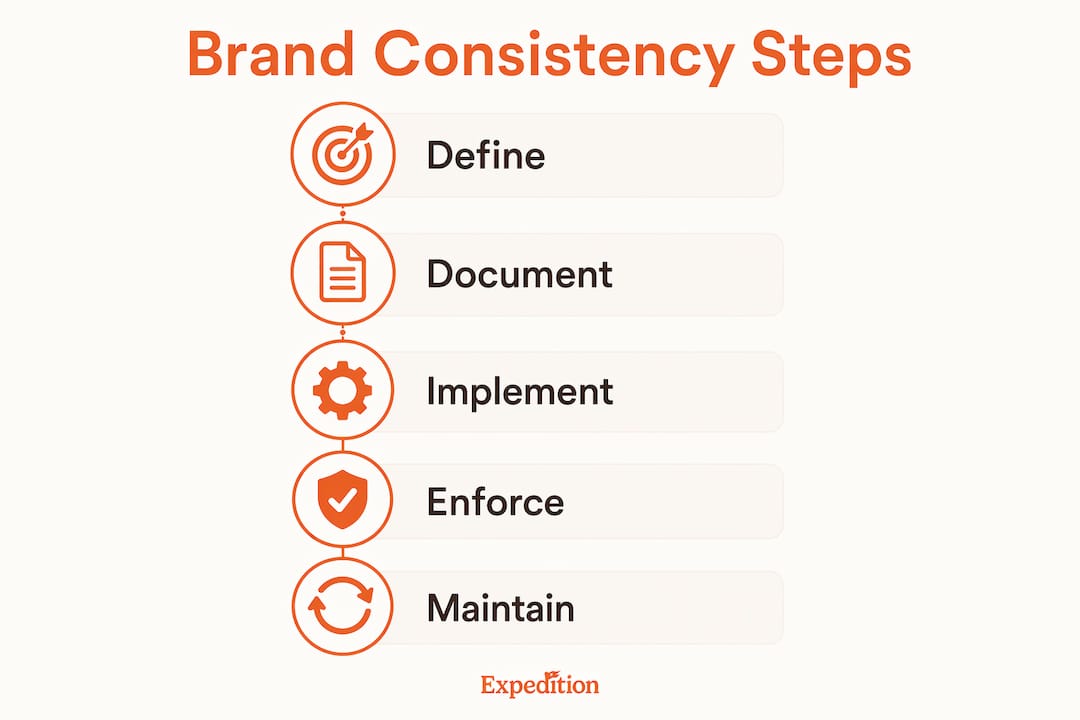
The problem most businesses encounter is that a design system without active governance is just a style guide nobody follows. Design systems promise consistency but mostly fail without someone actively enforcing rules and rolling back inconsistent changes. Nielsen Norman Group calls this role the enforcer, and it is a defined position, not a passive responsibility.
The enforcer role includes three core functions:
- Approving exceptions. Not every design request fits neatly into existing components. The enforcer evaluates whether an exception is justified or whether the system needs to evolve.
- Rolling back inconsistencies. When a developer or designer introduces a one-off style that breaks brand rules, the enforcer catches it before it ships or corrects it post-launch.
- Educating the team. The enforcer trains new contributors on system rules and communicates updates when components change.
“Without executive support, enforcing design system rules becomes ineffective and is often ignored by teams.” — Nielsen Norman Group
Executive backing is not optional. When the enforcer has top-down authority, their decisions carry weight. Without it, teams treat brand guidelines as suggestions. Engineering teams benefit directly from this structure too. Engineers benefit from consistent design systems by focusing on complex development tasks instead of making small, repeated visual adjustments that should already be standardized.
How do content inventory and journey mapping align your site for conversion?
A content inventory is a structured catalog of every page, post, and asset on your website, documented with ownership, performance data, and a recommended action for each item. Journey mapping assigns each piece of content to a specific stage in the buyer’s journey, from awareness through consideration to decision. Together, these two tools form the strategic backbone of any website redesign or brand alignment project.
Content inventory with journey mapping tracks what to keep, rewrite, merge, remove, or add, with defined owners and actions for each item. This prevents the most common and costly redesign mistake: carrying forward outdated, redundant, or off-brand content into a new site structure.
The process works in four steps:
- Catalog every existing page. Record the URL, page title, primary topic, current traffic, and the team member responsible for that content. Tools like Screaming Frog or Google Search Console make this audit faster.
- Assign a buyer journey stage to each page. Awareness pages educate. Consideration pages compare and build trust. Decision pages convert. If a page does not clearly serve one of these jobs, it needs to be rewritten or removed.
- Define an action for every item. Keep, rewrite, merge with another page, redirect, or delete. Every page gets a decision, not a question mark.
- Align CTAs to journey stage. An awareness blog post should not lead with a “Buy Now” button. Mapping each page to a buyer journey job ensures your CTAs match visitor intent, which directly improves conversion rates.
This process also prevents scope creep during a redesign. When every content decision is documented before design begins, your designer and developer work from a defined scope rather than a moving target. If you are planning a redesign, reviewing the website redesign checklist from Expedition walks through how this inventory phase fits into the full project sequence.
Key takeaways:
Building a cohesive brand and website requires integrating content strategy, design systems, governance, and journey mapping from the start, not as afterthoughts applied post-launch.
| Point | Details |
|---|---|
| Start with content, not design | Draft real page copy before wireframing to align layout with actual messaging and CTAs. |
| Assign a design system enforcer | Consistency fails without someone actively rolling back deviations and approving exceptions. |
| Map content to the buyer journey | Every page should serve a defined job in the awareness, consideration, or decision stage. |
| Secure executive support | Top-down backing makes brand governance authoritative rather than optional. |


